
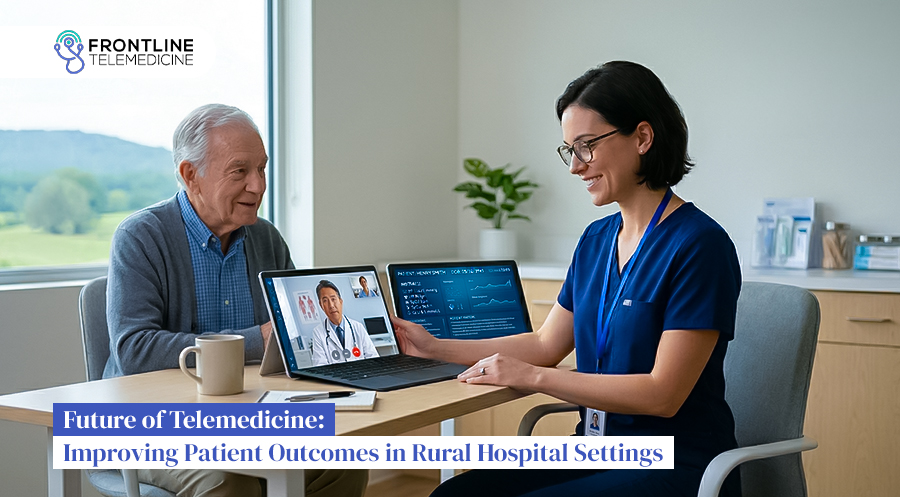
Rural hospitals are quietly reaching a breaking point that most healthcare discussions fail to address openly. Physician shortages, overnight staffing gaps, and limited specialist access are pushing critical access hospitals to their limits.
Patients in rural communities deserve the same quality of care as those in major cities. However, the infrastructure supporting rural healthcare has never truly lived up to that long-standing promise.
Telemedicine has changed that conversation in meaningful, measurable ways for hospitals across the country. At its core, telemedicine connects patients with physicians through secure video, audio, and digital communication tools. It removes the need for either party to be in the same physical location or even the same state.
It started as a supplemental care option and has grown into a full-scale clinical model. Today, it covers in-patient admissions, nighttime coverage, ICU support, and specialist consultations for rural facilities.
The future of telemedicine is actively reshaping how community hospitals deliver in-patient care and keep patients closer to home.
Are you still losing patients to unnecessary transfers or struggling to fill overnight shifts without burning out your rural hospital care team? Telemedicine offers a scalable, cost-effective solution that rural hospitals are already using to solve exactly these problems.
The present blog breaks down the challenges rural administrators face and how virtual care improves outcomes. We have also shed light on what implementation strategies actually work and what the future looks like.
Let’s dive in.
What is Telemedicine?
Telemedicine is the delivery of clinical healthcare services through secure digital communication technology. It connects physicians and patients remotely using video, audio, and real-time data tools. It’s an advanced healthcare model that removes geographic barriers that have historically limited rural communities’ access to quality medical care.
For hospitals, telemedicine is not a patient-facing app or a video call service. It is a structured clinical model in which board-certified physicians manage admissions, conduct virtual rounds, and supervise nursing staff. The physician is remote, but the care is real, immediate, and fully documented.
Hospitals dealing with thin staffing margins and unpredictable overnight demand are finding telemedicineextremely convenient. It is becoming a core operational strategy that directly impacts patient safety, staff performance, and financial sustainability.
Key Advantages of Telemedicine
- Real-Time Virtual Support
Board-certified physicians deliver real-time virtual coverage, closing dangerous gaps in overnight and weekend staffing.
- Reduced Patient Transfers
When a remote physician can assess and stabilize cases immediately, unnecessary patient transfers drop significantly.
- Nursing Staff Support
With telemedicine, your nursing staff can get direct physician backup during critical moments, reducing decision fatigue considerably.
- Lower Operational Costs
Virtual healthcare support reduces operational costs sharply compared to hiring full-time hospitalists or expensive locum physicians.
- Improved Patient Satisfaction
Patient satisfaction grows significantly when care stays local, consistent, and close to home rather than miles away.
Understanding Telemedicine in Rural Healthcare
Rural healthcare has always operated under a different set of rules. The nearest specialist can be hours away. On the other hand, overnight admissions are handled by skeleton crews. Furthermore, the pressure on your existing physicians never really stops building.
At the beginning, telemedicine did not arrive in rural hospitals as a futuristic experiment. It arrived as a practical answer to a staffing and access crisis that rural communities had been living with for decades. Critical Access Hospital Telemedicines across the U.S. were already operating at the edge of their capacity long before physician shortages made national headlines.
What makes telemedicine particularly relevant in rural settings is its ability to address deep-seated problems. The issue was never that rural hospitals lacked caring staff. The core pain point was that those staff members needed reliable physician support, which geography made consistently impossible to provide.
Telemedicine for remote patient care fills that gap in a structured and clinically sound way. A tele-hospitalist can manage in-patient admissions from a remote location. At the same time, your on-site team executes the plan, which makes it a complete collaborative approach.
A Tele-Nocturnist handles overnight cases without requiring a physician to physically commute to a facility at 2 AM. Virtual rounding keeps care moving efficiently during morning hours without adding travel time or cost.
There is also a financial dimension that rural hospital administrators cannot afford to ignore. Locum physicians are resource-intensive. It makes recruiting full-time hospitalists to rural areas notoriously difficult. Telemedicine solves both problems simultaneously by providing consistent, board-certified coverage at a fraction of the cost of traditional staffing.
Rural hospitals that have integrated telemedicine into their care model are delivering care that is measurably better. You can consider what consistent physician availability does for your facility beyond just clinical outcomes:
- It stabilizes your nursing staff.
- Reduces the frequency of emergency transfers.
- It keeps revenue local instead of sending patients and billing opportunities to larger urban centers.
Current Challenges in Rural Hospital Care
Community hospital administrators and clinical leaders carry a weight that most healthcare policy conversations simply do not capture. You are managing complex in-patient cases, emergency admissions, and overnight care with teams. However, these teams were never built to handle this volume on their own.
Well, these are not new problems, but they are getting harder to solve.
Surely, the rural hospital you are responsible for has encountered these 5 most pressing challenges:
1. Physician Shortages and Nighttime Staffing Gaps
It’s true that recruiting physicians to rural areas has always been difficult. Nevertheless, retaining them is a different challenge altogether. You may have coverage during the day, but nights and weekends are where the cracks start showing.
A single physician covering a 24-hour shift is not a sustainable model for anyone, including your patients.
Rural hospitals across the U.S. are increasingly relying on rotating locums or overburdened clinicians to fill those gaps. And, the results on care quality and staff morale are measurable. The problem is not effort. It is structural, and it needs a structural solution.
2. High Patient Transfer Rates and Their Impact on Outcomes
When your facility cannot quickly access a physician or specialist, the default response is to transfer the patient. That decision makes sense in genuine emergencies, but many transfers happen due to staffing limitations rather than a clinical crisis.
Each unnecessary transfer costs your hospital revenue and disrupts the patient’s care continuity. Additionally, it adds stress to a family that is already dealing with a health necessity. Studies consistently show that patients receiving treatment closer to home report better satisfaction scores. They also experience fewer complications during recovery.
3. Budget Constraints and the High Cost of Coverage
Remote care organizations operate on margins that leave very little room for financial error. Also, hiring full-time in-patient clinicians is expensive enough. Over the past several years, local physician rates have climbed sharply. The cost of maintaining 24-hour on-site physician coverage can strain even a well-managed facility budget.
You are constantly balancing the need for reliable coverage against what your revenue cycle can actually support. Such tension does not go away on its own. It requires a coverage model that is both clinically sound and financially realistic for a facility of your size and census.
4. Limited Access to Specialist Care
In regional hospitals, one of the most documented gaps is the availability of specialists. Your patients with cardiac conditions, neurological symptoms, or critical care needs cannot access the specialist without traveling significant distances. That delay and inconvenience are clinically dangerous for them.
A patient showing early stroke symptoms needs a neurologist within minutes. Rural care centers frequently lack the on-site specialist depth to manage these cases confidently. It leads to transfers, delayed diagnoses, and outcomes that could have been different with faster access to the specialist.
5. Geographic Barriers That Delay Time-Sensitive Care
Geography is perhaps the most stubborn challenge rural hospitals face. Your facility may serve a community spread across hundreds of square miles. Patients arriving late is common because they live far from your doors.
Moreover, skilled physicians hesitate to take rural positions due to isolation. It makes emergency response times longer. When a patient needs a higher level of care, the nearest facility may be an hour away by ambulance.
These are not something you can solve with better scheduling or stronger recruitment messaging alone. They require a fundamentally different approach to how care is delivered and who delivers it.
How Telemedicine Improves Patient Outcomes In Rural Hospitals?
Overburdened remote hospital staff are not looking for theory. Suppose it is a Tuesday night, and a complex admission just walked through your hospital door. Your on-call physician is unavailable at that exact moment. Your care organization needs solutions that hold up in situations exactly like these.
Telemedicine is delivering exactly that kind of real-world impact across community hospitals and critical access facilities nationwide.
Here is how it is making a measurable difference.
1. Faster Physician Response During Critical Cases
When a sick individual deteriorates overnight, every minute without physician input carries real clinical risk. Telemedicine puts a board-certified physician in front of your nursing team within minutes through a virtual cart or secure video connection.
There is no waiting for a callback or hoping a contract physician is close enough to respond in time. Your care team gets real-time orders, clinical guidance, and documented physician oversight immediately. That speed directly reduces the risk of adverse outcomes in time-sensitive situations like respiratory distress or chest pain.
2. Significant Reduction in Unnecessary Patient Transfers
Unnecessary transfers are among the most financially and clinically costly patterns in rural inpatient care. When your facility lacks immediate physician access, moving a care recipient to another facility feels like the safest default. Telemedicine changes that calculation entirely.
A remote tele-hospitalist can assess the individual, review labs, and make a confident clinical decision. Many cases that previously required a transfer are now safely manageable on-site. That means better continuity of care for the person receiving treatment and preserved revenue for your facility.
3. Consistent Overnight and Weekend Coverage without Burnout
Physician burnout is not a wellness issue alone. It is primarily a patient safety issue. When your hospitalists are covering extended shifts without relief, clinical judgment suffers, and errors become more likely.
Telemedicine introduces a sustainable coverage model in which a remote nocturnist handles overnight admissions and after-hours care. While the daytime physicians arrive rested and focused, your overnight care recipients receive attentive support.
4. Improved Access to Specialist-Level Support
One of the most tangible ways the future of telemedicineis reshaping rural care is through on-demand access to specialists. Community medical centers and small regional facilities rarely have full-time intensivists, neurologists, or cardiologists on staff.
Virtual medicine connects your care team with specialist physicians who can consult on complex cases in real time. In this way, individuals showing stroke symptoms get a neurological assessment within minutes. For many rural residents, this speedy access is the difference between full recovery and permanent impairment.
5. Strengthening Healthcare Accessibility in Rural Areas
Access to quality inpatient care should not depend on how close a community member lives to a major city. Improving healthcare accessibility in rural areas is the most documented and measurable outcome of telemedicine adoption across the U.S.
When your facility can offer consistent specialist consultations and real-time clinical oversight, individuals feel peace of mind.
At the same time, families stay together during difficult medical moments. Local facilities retain the clinical credibility to handle a broader range of cases.
Strategies for Implementing Telemedicine Successfully In Rural Healthcare
Adopting a new care model is never as simple as flipping a switch. You are working with limited budgets, existing staff who need training, and a community that depends on your facility to get this right.
The good news is that practical telemedicine solutions for rural hospitals are already proven and scalable. Additionally, they are designed to work within the operational realities of smaller facilities.
These 4 strategies below can make the telemedicine solutions actually work on the ground.
1. Start with Your Biggest Coverage Gap, Not Your Biggest Ambition
Identify the specific hours where your care team is most vulnerable. You need to build your tele-hospitalist model around that window first. A focused rollout gives your staff time to adapt and delivers measurable results faster than a facility-wide overhaul.
2. Choose the Right Technology Infrastructure before Onboarding Physicians
Your facility needs stable internet, compatible EHR access, and properly positioned virtual care carts. Before your first remote hospitalist logs in, thoroughly test every system component. Reliable technology is what separates a successful rollout from a frustrating one.
3. Train Your On-Site Team to Work with Remote Physicians Effectively
Train your nurses to initiate a virtual consult and to have the necessary clinical information ready. When your on-site team feels confident working alongside a remote care provider, response times improve, and recipients receive faster attention.
4. Align Your Telemedicine Model With Regulatory and Reimbursement Requirements
Remote physician coverage must meet state licensing, credentialing standards, and CMS billing guidelines. Work with your compliance team before going live.
Getting documentation and billing structure right from day one protects your revenue cycle and keeps your program audit-ready.
Future of Telemedicine in Rural Hospital Settings
Rural healthcare is standing at a genuinely significant turning point. The staffing models that community medical centers relied on for decades are no longer sustainable. Care recipients in underserved areas are demanding better access, faster responses, and more consistent physician availability. Telemedicine trends point toward a future where virtual care is not supplemental. Rather, it is the primary infrastructure holding rural inpatient care together.
Artificial intelligence is beginning to assist remote physicians with real-time diagnostics, flagging deteriorating patients before a crisis develops. Tele-ICU services are expanding into smaller community hospitals that previously had no access to critical care specialists overnight.
The reimbursement landscape is also shifting in favor of rural telemedicine adoption. Federal programs are increasingly recognizing virtual physician coverage as a legitimate and billable care model. For rural hospital administrators, the window to build a resilient care model around telemedicine is open right now.
Frontline Telemedicine Is Bridging the Gap between Rural Hospitals and Better Patient Outcomes
Rural healthcare cannot afford to wait for perfect conditions. The staffing gaps, coverage challenges, and access barriers facing community medical centers are real and pressing.
At Frontline Telemedicine, we understand the operational weight your facility carries every single day. Our range of effective telemedicine solutions is built specifically for hospitals like yours, where consistent physician coverage directly saves lives and strengthens communities.
The future of telemedicine belongs to the facilities that act decisively today. Let us help your hospital build a smarter, more sustainable care model.
Contact our team and take the first step toward stronger outcomes for your patients and your facility.