
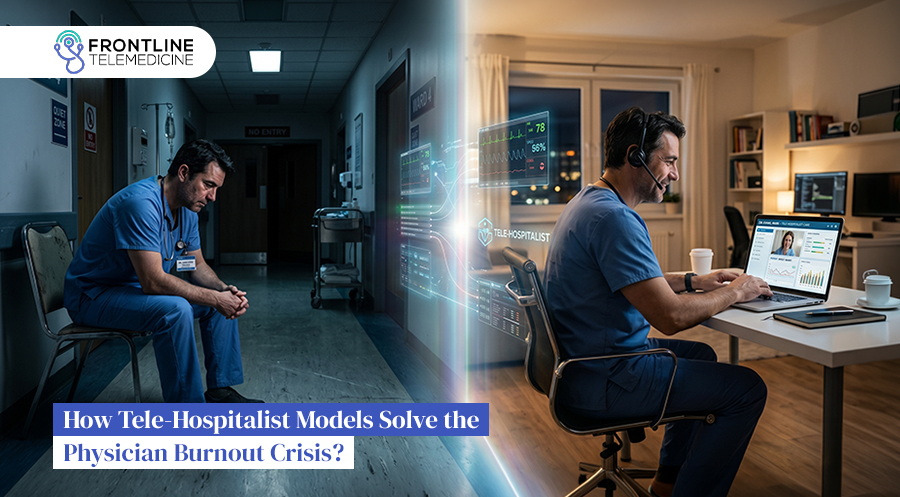
As more doctors have trouble showing up, America’s hospitals are getting closer to breaking point. Hospitalists, in particular, have to deal with heavy workloads, long hours, and constant clinical pressure, often without enough structural support. Physician Burnout is no longer an exception; it’s becoming the norm, especially in remote and high-demand settings.
As exhaustion rises, hospitals are seeing the effects right away: more staff turnover, fewer staff members, higher costs, and risks to patient care. This crisis is getting worse and needs more than quick fixes.
The tele-hospitalist model is a structural solution that allows for continuous clinical coverage without putting too much stress on on-site teams.
The following guide breaks down the mechanics of the physician burnout crisis and explores how virtual integration provides a sustainable path forward. We’ll walk through the core aspects of the tele-hospitalist model, its tangible benefits, and supporting clinical evidence.
Key Takeaways:
Below is a glimpse of the core insights you will find in this blog:
- Implementing virtual integration provides the essential structural relief needed to dismantle toxic physician workloads and prevent professional exhaustion.
- Hospitals can significantly reduce turnover expenses and recruitment losses, which frequently exceed $500,000 for a single physician.
- Achieving faster nighttime response times through remote coverage directly enhances patient safety and improves overall clinical outcomes.
- Strategically blending remote and on-site models allows your facility to maximize coverage efficiency without overextending your local team.
- Tele-hospitalist programs offer a reliable way to stabilize staffing and maintain high-quality care in underserved communities and rural hospitals.
What Is a Tele-Hospitalist Model?
A tele-hospitalist model delivers inpatient physician coverage remotely through secure video and digital infrastructure. Board-certified hospitalists manage admissions, overnight calls, and clinical decisions from a remote command center. It fills the critical staffing gaps without adding to the workload of on-site medical teams.
Tele-hospitalist services provide real-time remote physician coverage for inpatient hospital care. These services handle admissions, night calls, rapid response consultations, and cross-coverage coordination remotely. They operate through HIPAA-compliant (Health Insurance Portability and Accountability Act) video platforms integrated with your hospital’s electronic health records.
How Telemedicine Enables Virtual Hospital Care
Telemedicine for hospitalists works through a combination of:
- Secure video.
- Remote Electronic Health Record (EHR) access.
- And bedside nurse coordination.
A remote physician connects directly with nurses and patients through a mobile or fixed video unit.
The physician reviews labs, imaging results, and patient history in real time on a shared platform. They write orders, update documentation, and communicate decisions as if physically present in the hospital. However, note that it is not a call center operation. These are licensed, credentialed physicians managing real inpatient cases.
Response times often match or beat traditional on-call models because no one is commuting at 2 a.m. The physician is already at the workstation, alert, and focused exclusively on your patient population. When your hospital starts using this model, you can see measurable improvements in response time and documentation quality.
Synchronous vs. Asynchronous Tele-Hospitalist Coverage Models
Synchronous coverage means the remote physician is live and available in real time during assigned hours. Nurses can initiate an immediate video consultation for any clinical concern without waiting for a callback. A model like this works best for overnight and weekend coverage when rapid response is critical.
Conversely, asynchronous coverage handles non-urgent tasks such as medication reconciliation, documentation, and discharge planning remotely. In this regard, the physician reviews cases and responds within a defined time window based on clinical urgency.
You can maximize your coverage efficiency and patient safety by blending both models within your tele-hospitalist program.
| Feature | Synchronous Coverage | Asynchronous Coverage |
| Availability | Real-time, live physician | Defined response window |
| Best For | Overnight & weekend emergencies | Med reconciliation, discharge planning |
| Response Speed | Immediate video consult | Based on clinical urgency |
| Ideal Setting | High-acuity, rapid response needed | Stable patients, documentation tasks |
Understanding the Physician Burnout Crisis
Professional burnout is not a mindset problem. It’s a structural failure that the healthcare system created over decades. Hospitalists sit at the intersection of every pressure point in modern hospital medicine.
Take a look at the arguments below to understand why the traditional staffing model is no longer sustainable.
What Is Physician Burnout?
The World Health Organization classifies physician burnout as an occupational syndrome with three core dimensions: emotional exhaustion, depersonalization, and a reduced sense of personal accomplishment. In clinical settings, burnout manifests as disengagement, increased errors, and higher absenteeism.
Burnout is a chronic condition with lasting consequences. Physicians experiencing burnout — especially in rural hospitals — are more likely to make medication errors and miss diagnostic cues. Recognizing the clinical definition helps hospital leaders treat it as the patient safety issue it is.
According to the AMA’s 2024 Organizational Biopsy data — the largest national survey of its kind — 43.2% of physicians reported experiencing at least one burnout symptom in 2024, down from 48.2% in 2023 and 53% in 2022. While the trend is encouraging, the rate among hospitalists remains disproportionately high. The physician burnout crisis has escalated steadily since the widespread adoption of electronic health records in 2009. Administrative burden grew faster than staffing support, and hospitalists absorbed most of that burden.
Why Hospitalists Face Disproportionate Burnout Risk
Most physicians see the same patients over time, building relationships that give their work meaning. Hospitalists rarely experience that continuity. They treat, discharge, and immediately reset for the next admission. This constant rotation of high-acuity patients with no longitudinal connection accelerates emotional depletion fast.
Night and weekend call responsibilities fall heavily on hospitalist teams in most community and rural hospitals. A physician working a 24-hour shift, then covering the next morning’s rounds, operates in a dangerous state of fatigue. Wellness apps and resilience workshops cannot solve this. As a hospital leader, you need to implement structural changes to reduce physician burnout in this group.
In rural settings, this burden grows even more acute. These facilities often lack the budget for large rotating teams. You may find a single hospitalist carrying the weight of the entire inpatient population indefinitely. Without backup, the psychological pressure of being a community’s sole decision-maker drives professional exits.
EHR documentation alone consumes an average of two hours per eight hours of clinical work for hospitalists. That administrative burden eats into rest time and reduces the quality of face-to-face patient interaction. The combination of documentation load, high acuity, and shift length creates a uniquely toxic workload profile.
The Hidden Cost: How Burnout Drains Hospital Resources
Replacing a burned-out physician may cost your hospital between $500,000 and $1 million in recruitment and productivity loss. This figure doesn’t include the indirect costs of temporary coverage, locum fees, and erosion of team morale. Burnout-related turnover is one of the most expensive yet preventable line items in hospital operations.
Patient safety takes a measurable hit when physician fatigue becomes chronic across a department — increased medication errors, longer lengths of stay, and lower satisfaction scores. Hospitalist burnout solutions that reduce this operational damage are therefore financially necessary.
How Tele-Hospitalist Models Directly Address Burnout
By integrating a feasible tele-hospitalist model, you are fundamentally shifting the weight off your shoulders to a specialized remote partner. The tele-hospitalist model doesn’t simply redistribute work. It fundamentally restructures how hospital coverage is delivered.
Each of the three mechanisms below targets a specific driver of burnout in the hospitalist workflow.
1. Reducing Workload and Shift Burden
Remote hospitalists absorb the overnight call volume that once fell entirely on your on-site physicians. Your day team goes home at a reasonable hour and returns rested for the next morning’s caseload.
In this regard, the shift distribution becomes more humane and clinically safer when coverage is shared with a virtual team.
2. Improving Work-Life Balance for Physicians
Physicians who know they will not face a midnight call begin to mentally recover between shifts. Sleep restoration alone improves clinical performance, decision quality, and empathy in patient care. Virtual hospitalist care gives your on-site physicians a predictable schedule — the foundation of sustainable practice.
3. Minimizing Administrative Overload
Administrative burden — particularly EHR documentation — ranks as the single leading cause of physician burnout. Studies show that hospitalists spend up to two hours on documentation for every eight hours of clinical work. That ratio is unsustainable and directly erodes both physician well-being and patient care quality.
Remote hospitalists handle a significant portion of overnight documentation and order management during quieter hours. This reduces the documentation backlog that on-site physicians face each morning. Remote inpatient care management creates a natural task division that keeps your day team focused on clinical priorities, not charting.
When tele-hospitalists manage overnight orders and discharge planning remotely, your on-site physicians walk in each morning without the cognitive burden of an unresolved overnight queue. The benefits of inpatient telehealth monitoring enable hospitals to provide continuous clinical oversight without overburdening on-site staff.
Key Benefits of Telemedicine in Hospital Settings
Beyond simply filling staffing gaps, telemedicine in the hospital system delivers operational and clinical advantages. These 5 core benefits represent outcomes that administrators, CMOs, and hospitalist teams consistently report.
Each benefit addresses a real problem that traditional staffing models have failed to solve:
Significant Reduction in Physician Turnover Costs
Hospitals that implement virtual hospitalist services see meaningful reductions in physician attrition rates over 12 to 24 months.
Physicians who carry a balanced schedule stay longer, perform better, and mentor their colleagues more effectively. Reduced turnover translates directly into lower recruitment spending and more stable patient care teams.
Faster Nighttime Response Times
A remote hospitalist stationed at a dedicated workstation responds to nursing calls within minutes, not 30 minutes. Expect zero commute time, no grogginess, and no delay. Faster response at 3 a.m. means fewer escalations, fewer transfers, and better outcomes for critical patients.
Replacing Locum Dependency with Cost-Effective Virtual Coverage
Locum physicians are expensive, inconsistent, and often unfamiliar with your hospital’s systems and culture. A structured tele-hospitalist program provides predictable coverage at a fraction of the locum-billing rate. Telemedicine delivers budget-friendly scalability that locum arrangements simply cannot match.
Improved Patient Safety and Satisfaction
Rested, supported physicians make fewer errors and communicate more clearly with patients and their families. Patients treated by attentive night-coverage teams have better experiences and shorter lengths of stay. When the physician is focused and the handoff is clean, the patient always feels the difference.
Expanded Coverage Reach for Rural and Post-Acute Facilities
Small rural hospitals and skilled nursing facilities struggle to recruit full-time hospitalists for overnight coverage. A tele-hospitalist program connects these facilities to board-certified physicians without requiring local recruitment. Treat-in-place capabilities improve, ER transfers drop, and the facility retains more revenue per patient episode.
Real-World Results: What the Data Says About Tele-Hospitalist Programs
Healthcare leadership is moving away from theoretical solutions toward data-driven interventions. Analyzing outcomes and retention proves that virtual integration is now a measurable clinical success.
The case studies below show how hospitals use tele-hospitalist coverage to stabilize their workforce and improve inpatient care. You will see how structural changes translate directly into improved bottom lines and a revitalized medical staff.
Post-Acute and Skilled Nursing Facility (SNF) Settings
Research published in the American Journal of Managed Care documented the impact of telemedicine on skilled nursing facility outcomes. Facilities using remote physician coverage saw emergency transfer rates fall by up to 26% over 12 months.
Nighttime and Weekend Coverage
An anonymous community hospital group in the Southeast added virtual nighttime coverage after 2 hospitalists resigned in one quarter. Response times dropped from an average of 28 minutes to under 7 minutes for nursing-initiated calls.
The group reported zero locum spending in the following fiscal quarter and improved HCAHPS (Hospital Consumer Assessment of Healthcare Providers and Systems) scores by 11 points.
Rural and Underserved Hospitals
According to an anonymous report, a 48-bed critical access hospital in the rural Midwest struggled with overnight coverage gaps for 3 years. After deploying a tele-hospitalist program, the facility reduced ER transfers by 31% within six months.
Physician satisfaction scores improved eventually, and the hospital retained its 2 on-site hospitalists who had been considering leaving.
High-Volume Urban Hospitals
A published study in the Journal of Hospital Medicine examined the implementation of tele-hospitalists across a multi-site urban system. Researchers found improved throughput, reduced length of stay, and increased physician satisfaction.
Challenges and Considerations of Tele-Hospitalist Models
Every structural solution comes with implementation realities that your care center must prepare for in advance. While considering the tele-hospitalist model, these 3 areas require deliberate planning, stakeholder alignment, and clear operational protocols.
Knowing the challenges upfront prevents mid-implementation surprises that derail otherwise strong programs:
Technology and Infrastructure Requirements
Reliable broadband, HIPAA-compliant video platforms, and EHR integration form the technical backbone of any tele-hospitalist setup. If your facility features outdated infrastructure, it may face upfront investment costs before the program reaches full operational efficiency.
At minimum, your facility needs:
(1) dedicated high-speed broadband with redundant failover
(2) a HIPAA-compliant video platform integrated with your EHR
(3) a mobile video cart or fixed unit at bedsides, and
(4) IT support for onboarding and troubleshooting.
Partnering with an experienced tele-hospitalist provider simplifies the technology onboarding process significantly.
Regulatory and Licensing Considerations (U.S.)
Remote hospitalists must hold state-specific medical licenses for every state in which they provide coverage. Interstate Medical Licensure Compact participation simplifies multi-state credentialing for many physicians today.
CMS telehealth billing rules and hospital credentialing requirements add another compliance layer that you have to manage carefully.
Overcoming Adoption Resistance from Care Teams
Due to unfamiliarity with the workflow, nursing staff and on-site physicians sometimes resist virtual coverage models. In this context, structured onboarding, pilot programs, and clear escalation protocols help build trust and adoption across care teams.
Your fastest path to earn buy-in at every level includes leadership communication and early wins.
The Future of Tele-Hospitalist Models in Healthcare
Telemedicine has moved beyond a temporary fix. It’s becoming essential hospital infrastructure as physician shortages continue to grow.
The Association of American Medical Colleges estimates a shortage of up to 86,000 physicians by 2036, placing added strain on hospitalist programs. Facilities relying only on on-site coverage will face rising recruitment challenges, higher locum costs, and widening care gaps. Those investing in virtual care now will be better positioned to compete.
At the same time, AI and predictive analytics are strengthening remote care. These tools help tele-hospitalists monitor patients, identify risks early, and manage complex cases more efficiently—enhancing, not replacing, clinical expertise.
The future of tele-hospitalist models in healthcare points toward a hybrid care approach, where virtual and on-site teams work seamlessly together. As burnout and staffing pressures persist, tele-hospitalist programs are shifting from optional to essential, giving early adopters a clear long-term advantage.
Build a Sustainable Tele-Hospitalist System with Frontline Telemedicine!
The burnout crisis will not fix itself. But your facility can take a concrete step forward starting today!
At Frontline Telemedicine, we built our model around a simple belief: physicians deserve to practice sustainably. Your hospital deserves reliable coverage without burning through its best clinicians in the process.
Our custom tele-hospitalist programs serve critical access hospitals, community facilities, SNFs, and practice groups across the country.
We bring board-certified physicians, proven workflows, and responsive support to every partnership we take on. Our approach reduces overnight call burden, cuts locum dependency, and protects the physicians your patients count on.
Contact Frontline Telemedicine for a no-obligation consultation. Let us show you how our tele-hospitalist coverage model works for facilities like yours.
Frequently Asked Questions (FAQs)
Q1. How is a tele-hospitalist different from a traditional telemedicine consult?
Unlike a one-time specialist consult, a tele-hospitalist manages your patient’s entire stay. They act as a core part of your team – handles admissions, daily rounding, and discharges just like a physician standing right beside you.
Q2. Can tele-hospitalists write orders, prescribe medications, and handle emergencies remotely?
Absolutely. Through integrated EHR access, these professionals input real-time orders and prescriptions. In emergencies, they lead the code via high-definition video, directing on-site staff with expert precision to ensure immediate intervention.
Q3. What size hospital benefits most from a tele-hospitalist program?
While large centers use them for surge support, small to mid-sized community and rural hospitals often see the biggest impact. It provides them with high-level coverage that would otherwise be difficult or impossible to recruit.
Q4. Can telemedicine completely replace in-person hospitalists?
No, and it shouldn’t. The ultimate goal here is to create a “hybrid” approach. You need hands-on clinicians for physical procedures. Nevertheless, tele-hospitalists provide the essential relief and 24/7 coverage that keeps your on-site team from reaching total burnout.
Q5. How long does it take to implement a tele-hospitalist program?
Typically, you can be up and running within 60 to 90 days. It includes credentialing, technical setup, and workflow integration. Frontline Telemedicine works closely with your leadership to ensure the transition is seamless and stress-free.
Q6. Are tele-hospitalist services suitable for small hospitals?
For small facilities, they’re a lifeline. Access to specialized physicians is extremely crucial without the massive overhead of full-time staffing. In this way, small hospitals can keep patients local, maintain high safety standards, and significantly increase their revenue.
Q7. What technologies are required to implement a tele-hospitalist program?
You only need reliable high-speed internet, a mobile video cart or tablet, and EHR access. We keep it simple so your staff can focus on the patient. Our model ensures that you don’t have to troubleshoot hardware or navigating complex new software.