
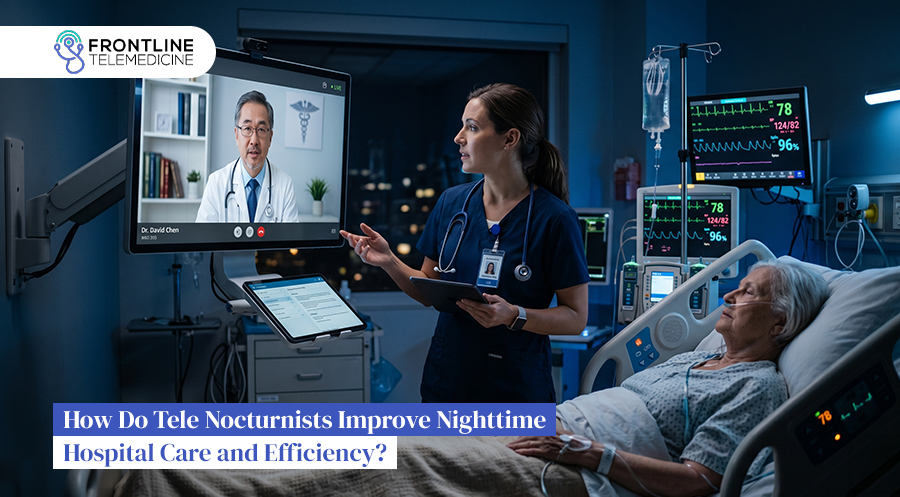
Hospitals may operate 24/7, but nighttime physician coverage remains one of the most vulnerable points in care delivery—especially in remote settings. Delayed responses, overworked on-call doctors, and rising patient dissatisfaction are common overnight challenges. Add to that the financial strain of locum tenens and increasing physician burnout, and the problem becomes even more critical—particularly for rural hospitals struggling to recruit night staff.
Tele Nocturnists offer a practical solution. These are remote, board-certified physicians who provide overnight inpatient care through secure telemedicine platforms. They ensure timely clinical decisions, reduce staff burden, and deliver consistent care without the cost of full-time, on-site coverage.
For hospital leaders, adopting tele-nocturnist models can transform nighttime operations from a staffing liability into a reliable, efficient system that improves both care quality and workflow.
Key Takeaways
- Nighttime care gaps lead to higher clinical risk and staff burnout
- Tele Nocturnists provide consistent, real-time overnight coverage
- They reduce dependency on costly locum physicians
- Improve response times, patient outcomes, and nurse satisfaction
- Especially valuable for rural or understaffed hospitals
- A scalable, cost-effective solution for 24/7 care continuity
Who Are Tele-Nocturnists?
A Tele Nocturnist is a licensed, hospital-credentialed physician who provides overnight clinical coverage through a secure telehealth platform. Unlike a general on-call physician, the nocturnist role is based on nighttime hospital care. These physicians remotely handle admission assessments, rapid response calls, medication orders, and urgent clinical decisions.
Remote night-shift practitioners are not a backup plan. They are active, responsive providers integrated directly into a hospital’s care team. They communicate in real time with bedside nurses and can act on escalating patient situations within minutes.
Facilities report faster response times with a remote nocturnist than with a physically present but overwhelmed on-call physician.
The scope of their work spans inpatient rounding support, overnight admissions, documentation, and cross-facility coverage. If you’re leading a smaller facility, this coverage prevents dangerous understaffing and ensures safe overnight operations.
Technology Behind Remote Nocturnist Services
Remote nocturnists primarily rely on HIPAA-compliant (Health Insurance Portability and Accountability Act of 1996) video platforms. Along with this, integrated EMR (Electronic Medical Record) access and real-time patient monitoring dashboards also play crucial roles.
Secure audio and video connections enable real-time virtual assessments, data review, and instant nurse collaboration. Encrypted systems support multi-screen monitoring and electronic orders, matching the capabilities of an on-site provider.
Workflow Integration in Hospitals
A Tele Nocturnist can connect directly to your hospital’s existing workflow tools. From EMR access to nurse communication portals, the integration feels seamless. Your hospitals can assign the remote physician to specific patient panels each shift.
Nurses can easily use a single-click escalation protocol to reach the physician, and response times run under 3 minutes.
How Do Tele-Nocturnists Work?
Telemedicine is transforming remote healthcare accessibility in a disruptive way.
A night-shift tele-hospitalist operates as a fully credentialed member of your hospital’s medical staff from a remote locati
on. At the start of every shift, the physician logs into a secure telehealth platform. From here, they seamlessly access your hospital’s EMR, patient census, and direct lines of communication with the nursing team.
The physician then manages clinical decisions, responds to escalations, and documents in real time throughout the overnight period.
Below, we have explained how these professionals work in detail:
Shift Handover and Census Review
At the start of each shift, the Tele Nocturnist receives a detailed handoff from the outgoing day team. The physician reviews active patient charts, flags high-acuity cases, and coordinates with on-site nurses to establish priority watchlists.
Such a structured handoff process reduces the risk of missed escalations during the transition to nighttime care.
Real-Time Escalation Response
When a patient deteriorates, the escalation goes directly to the nocturnist through a secure video call. Within minutes, the professional conducts a virtual assessment, reviews vitals and labs, and issues orders.
A bedside telehealth cart can enable physicians to perform live, face-to-face patient examinations remotely.
Admission Management and Documentation
Overnight admissions require rapid clinical decisions and accurate documentation. With a team of Tele Nocturnists, it’s effortless to handle admission histories and physical exams via video. They also complete electronic documentation and ensure appropriate care plans are in place before morning rounds.
This removes the documentation burden from your day-team physicians and keeps records current throughout the night.
Morning Handoff and Continuity Planning
Before the shift ends, the virtual nocturnist prepares a structured morning handoff summary for the incoming day team. Any overnight changes in patient status, new admissions, or pending follow-ups are clearly documented.
The handoff ensures the day team starts with full situational awareness and no gaps in overnight care documentation.
Key Advantages of Tele Nocturnists
Reportedly, hospitals that adopt Tele Nocturnist coverage consistently report improvements across three dimensions:
- Clinical quality
- Operational efficiency
- Physician wellbeing
These are not incremental gains. For many facilities, the switch represents a fundamental upgrade in how overnight care is structured and delivered.
These advantages illustrate how Tele Nocturnists transform overnight care delivery and impact hospital operations:
1. Patient Safety
You can reduce clinical risks for vulnerable overnight patients with immediate expert responses. Expect timely interventions and safer outcomes during your night shifts.
2. Operational Efficiency
During low-staffing hours, Tele Nocturnists handle admissions and documentation effectively. Practical virtual services allow your on-site teams to focus on urgent bedside tasks.
3. Staff Wellbeing
Your on-site physicians gain respite from grueling overnight shifts and high stress. A highly functional virtual support boosts overall retention rates and improves your staff’s wellbeing significantly.
4. Financial Stability
You can significantly reduce reliance on expensive, external, or temporary locum staff. Telemedicine optimizes resource allocation and stabilizes your annual budget effectively.
How Does Tele-Nocturnist Coverage Improve Staffing?
In remote healthcare, recruitment for overnight physician coverage is one of the hardest problems to solve. Candidates are scarce, compensation demands are high, and attrition rates are steep.
Nevertheless, remote nocturnists solve this without a single relocation offer. A solution like this delivers qualified physicians remotely to your facilities without the headache of your recruitment.
Here are 4 core benefits hospitals gain with Tele Nocturnist coverage:
- Immediate Staffing Gap Resolution
Rural and critical access hospitals can activate the coverage quickly, often within days. There is no need to post job listings, run credentialing from scratch, or wait months for candidates.
The coverage is ready and credentialed, filling gaps that would otherwise leave nurses without physician support overnight.
- Significant Cost Reduction
On-site nocturnists command high salaries, specifically in underserved areas. Locum physicians cost even more on a per-shift basis. Virtual hospitalist services deliver equivalent clinical oversight at a fraction of that cost.
As a result, your hospital can be able to reallocate budget toward other care priorities.
- Reduced Physician Burnout
Asking daytime hospitalists to cover overnight calls on top of full-day schedules accelerates burnout dramatically. Dedicated digital nighttime healthcare practitioners remove that burden entirely.
Day-team physicians return to focused schedules, which improves retention, performance, and morale across the medical staff.
- Scalable, Consistent Coverage
Patient census fluctuates from time to time. Tele Nocturnist models scale with demand. Providers cover multiple facilities simultaneously or flex coverage based on volume, giving hospital administrators a level of staffing flexibility that in-house models simply cannot match.
How Tele Nocturnists Compare to Traditional Night Coverage?
Choosing the right overnight coverage model requires an honest comparison. Traditional options, like in-house nocturnists or local professionals, carry real advantages. However, they also have limitations that grow more pronounced in rural or resource-constrained settings.
Virtual nocturnists offer a different value proposition, one that many facilities find more sustainable over the long term.
In-House Nocturnists vs. Tele-Nocturnists
In-house nocturnists offer immediate physical presence, which matters in high-volume trauma centers and ICUs. In these settings, hands-on procedures happen overnight. For most hospitals, Tele Nocturnists effectively manage overnight assessments, medication, and documentation via secure video.
The recruitment challenge for in-house nocturnists is real. Physicians willing to commit to permanent overnight schedules are rare. Remote night hospitalists face no geographic limitations.
Thus, they can make qualified coverage accessible if your care center cannot attract or retain in-house staff. For critical access and rural facilities, this distinction often determines feasibility.
Flexibility and Scalability
After-hours tele-nocturnist models adapt to changing census efficiently. They expand themselves to cover multiple sites when patient volume rises and scale back during slower periods. In-house structures are rigid. You have to pay for a physician regardless of patient volume.
Nocturnist coverage solutions let administrators like you optimize staffing budgets without compromising overnight care quality.
The table below summarizes how the 3 main coverage models compare across key performance factors:
| Factor | On-Site Nocturnist | Locum Physician | Tele Nocturnist |
| Cost | High | Very High | Cost-Effective |
| Availability | Limited by geography | Short-term only | 24/7 hospital staffing solutions |
| Physician Burnout Risk | High | Moderate | Low |
| Scalability | Low | Moderate | High |
| Rural Suitability | Poor | Variable | Excellent |
Benefits of Telemedicine in Rural Healthcare
Rural hospitals operate under a different kind of pressure. Workforce shortages, geographic isolation, and thin operating margins make every staffing decision high-stakes.
Telehealth hospital coverage has emerged as one of the most impactful tools available to rural healthcare administrators. Check out the benefits below to improve your physician access without the impossible task of relocating providers:
Addressing Physician Shortages in Rural Areas
The rural physician shortage is not a recent development – it has been building for decades. Recruitment incentives, loan forgiveness programs, and rural health initiatives have definitely helped. But the gap remains wide.
Inpatient telemedicine care sidesteps the geography problem entirely. It connects rural hospitals with qualified physicians who can provide consistent, credentialed coverage regardless of location.
Hospitals that once operated with unsafe staffing ratios now have structured overnight medical coverage. You’ll also have documented response times and the capability of holding full clinical accountability.
Enhancing Emergency and Critical Care Access
When a rural patient deteriorates at 3 AM, the difference between a rapid physician response and a 45-minute delay can determine the outcome. Telemedicine nocturnists enable faster escalation pathways. The physician is already present on the platform, engaged, and ready to act.
For critical access hospitals, this capability strengthens their ability to treat patients in place. Reduce unnecessary transfers that burden both patients and the hospital’s revenue.
Supporting Nursing Staff Confidence
Nurses working overnight in your rural facility carry enormous responsibility. When physician access is uncertain or delayed, clinical decision-making falls to them in situations that exceed their licensed scope.
Having reliable remote nocturnists around the clock gives your nursing staff a reliable escalation point. Their confidence, performance, and job satisfaction – all improve with consistent physician support throughout the shift.
Strengthening Hospital Financial Viability
Overnight staffing costs represent a significant portion of a rural hospital’s operating budget. A physician presence that costs a fraction of an on-site hire changes the financial equation.
Your hospital will retain more revenue, reduce transfer-related losses, and build a stable operating model without compromising care quality.
Compliance, Security, and Regulatory Considerations
Adopting a Tele Nocturnist system is a regulatory and risk management decision. Care facilities must ensure their chosen coverage framework satisfies federal and state requirements. At the same time, it should protect patient data and properly address liability.
The good news is that established providers have already built compliance into their operational framework:
- HIPAA Compliance in Telemedicine
All telemedicine communications, including video consultations, patient data transfers, and electronic documentation, must comply with HIPAA regulations. A reputable Tele Nocturnist provider uses encrypted, HIPAA-compliant platforms.
They have access controls, audit logs, and business associate agreements – all in place. The goal is to safeguard patient privacy at every point of the virtual care encounter.
- Licensing and Credentialing
A remote emergency night physician must possess a license in the state where the patient is located. Credentialing also requires hospital-specific privileging, confirming that the physician meets the facility’s standards for inpatient care.
Established providers manage multi-state licensing and hospital credentialing as part of their service. They ensure the coverage is legally compliant and ready to deploy without administrative delays.
- Risk Management and Liability
Liability in Telemedicine follows the same standard of care principles as in-person medicine. Tele-based nocturnists must carry malpractice insurance covering remote inpatient care. Moreover, your facility needs to document its virtual coverage arrangements clearly.
Structured escalation protocols and documented electronic records support a strong liability defense. Be able to demonstrate a commitment to clinical accountability across the overnight coverage model.
Best Practices for Successful Tele Nocturnist Implementation
A Tele Nocturnist program delivers results when you implement it with intention. Facilities that experience the strongest outcomes treat deployment as a structured clinical integration.
The practices below define what successful implementation looks like in real hospital environments:
- Standardize Your Escalation Protocol Before Go-Live
Your nurses need to know exactly how and when to contact the Tele Nocturnist. Establish a clear, written escalation protocol before the service launches. We suggest that you define response time expectations and communicate the protocol to every nursing shift. It’s also essential to conduct a simulation run before the first live coverage night.
- Ensure Full EMR Integration
The telemedicine night shift providers must access the same patient records your on-site team uses. Incomplete EMR integration creates information gaps that compromise clinical decision-making.
Work with your IT team and provider to configure full read/write access and documentation tools before the service activates.
- Conduct Staff Education Across All Shifts
Every nurse, hospitalist, and ancillary staff member who interacts with the overnight coverage model needs orientation. Cover how the platform works, who the nocturnist is, what their scope is, and how to troubleshoot basic connectivity issues.
- Define Clear Handoff Standards
Consistent handoff between day hospitalists and the incoming Tele Nocturnist prevents care gaps. Use a structured format such as SBAR (Situation, Background, Assessment, Recommendation) for every shift transition. It’s essential to document the handoff within the EMR to create an auditable record.
How To Choose the Right Telemedicine Partner?
Not all telemedicine providers offer the same depth of clinical experience, regulatory compliance, or operational support. The right partner integrates seamlessly into your facility’s culture, workflow, and care standards.
Here’s what to evaluate when making that choice.
- Board-Certified Physicians with Inpatient Experience:
Overnight hospital coverage requires more than general physician credentials. Look for providers whose nocturnists hold board certification in internal medicine or hospital medicine and have documented inpatient experience.
- Proven Track Record with Similar Facilities:
Ask for references from hospitals that match your size, patient population, and location. A provider experienced with critical access hospitals in rural settings understands your workflow pressures differently than one focused solely on large urban health systems.
- Transparent Pricing and Contract Terms
Avoid providers with opaque pricing structures or contracts that lock you into long-term agreements without performance protections. Understand exactly what’s included, coverage hours, credentialing support, platform maintenance, and escalation protocols, before signing.
Frontline Telemedicine is one provider worth considering for hospitals exploring Tele Nocturnist services. We serve hospitals, physician practice groups, and post-acute facilities, offering nocturnist coverage specifically designed for nighttime staffing challenges.
Our dependable team focuses on reducing staffing costs and maintaining consistent clinical quality without the overhead of a full-time physician. Our framework revolves around facilities that need reliable overnight coverage and want a solution that fits their existing workflow.
Future of Tele Nocturnists in Healthcare
The trajectory for Tele Nocturnist adoption is moving in one clear direction. In the coming years, more hospitals will depend on remote overnight coverage as physician workforce shortages deepen nationally. The pipeline of physicians entering inpatient medicine hasn’t grown fast enough to meet demand. Rural areas feel that gap most acutely.
The future of Telemedicine is faster, accessible, technology-driven care. Advances in remote patient monitoring will expand what a Tele Nocturnist can assess and manage. Continuous vital sign feeds, AI-assisted early warning systems, and bedside telehealth carts are changing what remote care looks like.
Within the next 5 years, night shift physician shortage solutions will look dramatically more capable than current models.
Regulatory frameworks are also evolving. Interstate licensing compacts have made multi-state physician coverage faster to activate. More states are expected to join these compacts. This will reduce the credentialing lag that currently slows Tele Nocturnist deployment. Policy momentum is aligning strongly with clinical and operational demand.
The hospitals that invest in building strong Tele Nocturnist infrastructure now will hold a structural advantage. They’ll increasingly carry lower staffing costs, higher overnight care consistency – resulting in greater operational resilience.
Your Nights Deserve a Reliable Clinical Partner!
Nighttime hospital care has never been a problem with easy answers. But Tele Nocturnists come remarkably close. Frontline Telemedicine believes that every hospital, regardless of size or location, deserves consistent, qualified overnight coverage.
Our approach puts board-certified physicians directly into your overnight care team without the cost and complexity of traditional staffing.
If your facility is ready to close the nighttime coverage gap, we are ready to help. Reach out to us and let’s build a better night shift together.
Frequently Asked Questions
1. Are Tele Nocturnists as effective as in-person doctors?
For most overnight inpatient care needs, Tele Nocturnists deliver equivalent clinical outcomes. Studies and facility reports consistently show comparable patient satisfaction scores and similar complication rates.
Physical presence matters in procedural emergencies. Nonetheless, the majority of overnight hospital interactions fall well within what remote coverage manages effectively.
2. What types of hospitals benefit most from Tele Nocturnists?
Critical access centers, rural community hospitals, post-acute care facilities, and physician practice groups benefit most from Tele Nocturnist coverage. These settings face the steepest physician recruitment challenges and carry the highest risk from unstructured overnight staffing.
Urban facilities with difficult overnight recruitment environments also find the model highly practical for closing unpredictable census-driven gaps.
3. How quickly can a hospital implement Tele Nocturnist services?
With Frontline Telemedicine, implementation typically runs between 2 and 6 weeks. That timeline covers physician credentialing at your facility, EMR access configuration, staff orientation, and technology testing. Facilities that come prepared with clear workflow documentation and IT support tend to go live at the shorter end of that range.
4. Do patients feel comfortable with Telemedicine at night?
Patient comfort with telehealth has grown substantially in recent years. Most patients, once they experience a responsive virtual physician, report high satisfaction with the interaction. Transparent communication from nursing staff about how the virtual physician role works reduces initial hesitancy.
5. What factors should hospitals consider before choosing a telemedicine provider?
You need to evaluate physician credentials and inpatient-specific experience first. Then review the provider’s compliance framework, including HIPAA practices and multi-state licensing capabilities. After that, assess EMR integration experience with your specific platform, contract terms, and references from comparable facilities.
Pricing transparency matters. You need to understand exactly what’s in the coverage before signing. A provider that welcomes a discovery call and answers hard questions directly is a provider worth trusting.
6. Can Tele Nocturnists handle critical care situations?
Tele Nocturnists manage a broad range of critical situations remotely. For situations requiring bedside procedures or immediate surgical intervention, the role shifts to:
- Rapid care coordination.
- Supporting on-site nursing staff.
- Activating appropriate transfer protocols rapidly.
The physician’s value in those moments lies in speed of decision-making and coordination, not physical proximity.