
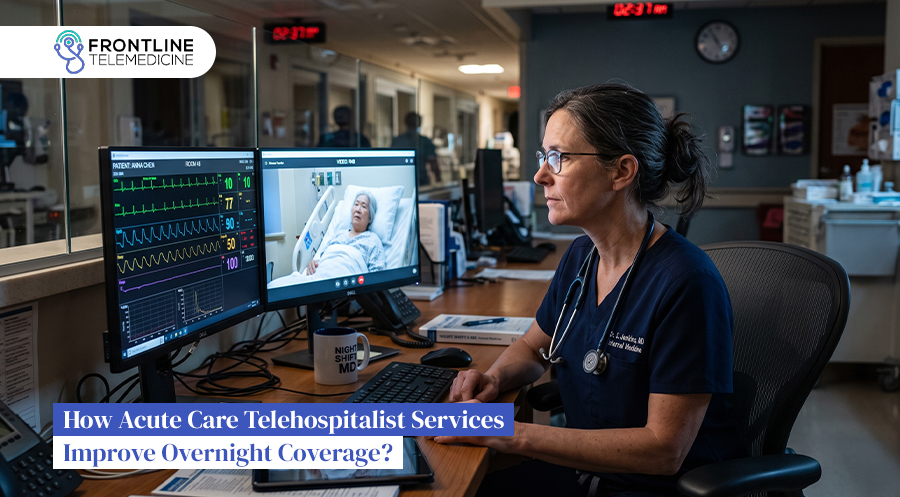
Across hospitals, overnight coverage gaps continue to pose serious risks to patient safety and clinical efficiency. Many facilities struggle with delayed physician response during night hours, increasing complications and operational stress.
You experience these challenges when staffing shortages leave overnight shifts undercovered. That’s the time when critical decisions are delayed significantly. Healthcare settings often rely on overstretched staff or costly locum tenens physicians, which reduces consistency and the quality of care.
Deploying Acute Care Telehospitalist solutions can strategically address this gap. With continuous physician support during overnight hospital operations, this approach improves response times and enhances patient outcomes. Your hospital can bridge staffing gaps, accelerate emergency department (ED) admissions, and reduce on-site physician burnout.
As a hospital leader, understanding how this service improves overnight coverage is crucial to combat and reduce avoidable transfers and lower costs.
The present blog explains how telehospitalist models for acute care improve hospitals’ efficiency, safety, staffing stability, and financial performance. Explore operational workflows, clinical benefits, and real-world applications of virtual inpatient coverage models.
What Is an Acute Care Telehospitalist?
An Acute care telehospitalist is a board-certified inpatient physician providing remote hospital coverage using secure clinical platforms. Hospitals use these physicians to manage admissions, coordinate treatment plans, and support inpatient teams during overnight shifts.
They operate through structured virtual hospitalist services integrated into hospital workflows. These physicians basically collaborate with on-site staff, nurses, and emergency teams across multiple departments.
Their role strengthens acute care operations by improving decision speed and reducing delays in treatment delivery. Your hospital can increasingly adopt acute care telemedicine systems to address staffing shortages. Simultaneously, it improves overnight clinical efficiency across inpatient environments that require continuous physician involvement.
How Does An Acute Care Telehospitalist Work?
An acute care telehospitalist uses advanced hospital systems to access patient records, communicate, and manage workflows in real time.
This allows them to support patients and staff overnight, even when the doctor is not physically present in the hospital. It’s an effective approach to make sure that care continues smoothly across all departments.
1. Patient Assessment
During night shifts, a telehospitalist reviews patient records, scans, and lab results to understand each patient’s condition.
They make decisions as per hospital protocols and help nurses with guidance and timely interpretation of data. The sole objective is to help every patient receive proper attention and support throughout the night.
2. Treatment Decisions
Telehospitalists recommend treatment changes, update medicines, or suggest new tests as soon as they see new patient data. Their decisions always align with the hospital’s rules. Moreover, they closely support nurses who handle complicated cases. Even at night, no patient is left waiting for care.
3. Emergency Response
If a patient’s condition gets worse, remote hospitalist physicians use real-time monitoring and strict protocols to respond quickly.
With fast action, it’s possible to reduce delays, help stabilize patients in critical condition, and keep hospital teams connected. Everyone works together to deliver urgent care overnight.
4. Order Management
Remote acute care physicians enter, review, and update orders for treatments, tests, or medicines using the hospital’s digital systems.
Their oversight keeps every medication, investigation, and treatment plan accurate. The tele-hospitalist model supports uninterrupted care and clear documentation for every patient throughout the night.
5. Team Communication
These virtual health professionals stay in constant touch with nurses and staff through secure digital platforms. In this way, everyone stays on the same page. During the overnight hours, this kind of teamwork speeds up decisions, reduces mistakes, and keeps departmental operations smooth.
How Acute Care Telehospitalist Services Support Overnight Clinical Operations?
During overnight hospital operations, health risks increase significantly. In these situations, the safety of the patients depends on timely clinical intervention. Virtual care physicians support operations by improving response times, strengthening clinical accuracy, and enhancing care quality.
Below are the ways they maintain continuous remote physician availability across inpatient environments:
1. Faster Emergency Response
An acute care telehospitalist enables rapid intervention during patient deterioration events. Faster response significantly improves stabilization, reduces complications, and enhances overnight hospital safety in critical inpatient care settings.
2. Reduced Delays
Your patients don’t have to wait for on-site physicians anymore. Tele-acute care physicians will receive timely diagnosis and treatment decisions. Reduced delays can improve hospital efficiency and strengthen overnight inpatient care operations.
3. Improved Monitoring
Continuous oversight supports early detection of patient deterioration during overnight hours. An improved monitoring strengthens patient safety by lowering complications and enhancing intervention speed.
4. Safer Transitions
Continuity of care is improved with structured handoffs between day and night teams. Remote acute care support teams can ensure that seamlessly. Communication gaps decrease while patient safety improves during overnight hospital operational transitions across departments.
5. Lower Complications
Early intervention of virtual health professionals reduces ICU escalation rates. They can also prevent avoidable deterioration events. Your hospital will achieve stronger outcomes, improved safety metrics, and better overnight care quality.
Key Benefits of Acute Care Telehospitalist Services for Hospitals and Care Teams
Many hospitals now turn to virtual inpatient care models to boost efficiency and save on operational expenses. Urgent care telehospitalist services step in to offer flexible overnight coverage. They make sure that hospital teams stay connected and well-staffed in different departments, night after night.
Here’s how these professionals benefit hospitals and critical care teams:
1. Cost Reduction
With structured virtual care, hospitals can cut down on costly locum tenens and save money each night. At the same time, there is always a doctor available overnight, so no department feels left out or has to manage without support.
2. Operational Stability
Virtual hospitalist services mean there is always a doctor on call at night, bringing peace of mind to everyone. No matter how busy the department gets, Hospital routines don’t get disrupted, and staff can count on reliable support.
3. Clinical Consistency
When remote hospitalists oversee care, treatment decisions follow strict protocols. That makes outcomes safer for every patient. Such consistency helps both doctors and nurses, giving families confidence that their loved ones are in good hands.
4. Faster Patient Flow
With quicker responses from doctors, admissions, transfers, and discharges happen smoothly, even on a hectic night. More beds open up, patient flow improves, and both staff and families feel the difference in hospital efficiency.
5. Scalable Coverage
Your hospital can now expand overnight coverage without hiring many more full-time staff – all thanks to urgent care models. As patient demand rises, these flexible solutions let your hospitals scale up easily. Be able to keep every department ready for anything.
How Acute Care Telehospitalist Services Help Reduce Physician Burnout?
Doctors feel exhausted and stressed when hospitals put all the night duty burden on their on-site teams. The lack of rest takes a toll on both their physical and mental health, often affecting patient care quality. Urgent care telehospitalist services help bring better schedules, and let doctors work together virtually – even at midnight.
This seamless new approach helps restore work-life balance and keeps the whole team in good spirits.
1. Reduced Night Workload
With smart virtual support, the doctors of your hospital setting no longer have to keep doing night shifts back-to-back. It means they can actually look forward to coming to work, knowing they will get enough sleep.
Less tiredness means they do their jobs better, feel happier at work, and provide safer care for their patients. Patients, too, benefit from doctors who are truly present and alert.
2. Shared Responsibility
Because of this transparent system, workload is shared fairly between doctors in the hospital and those working remotely. Such fair distribution helps prevent feelings of isolation or resentment among the staff.
Critical care telehospitalist models help doctors support each other during long nights. When everyone pitches in, the workplace becomes more positive and collaborative.
3. Better Scheduling Balance
Your care organization can now use fairer schedules so that the practitioners aren’t stuck with extra night shifts all the time. With this improvement, doctors can plan their personal lives better and spend more time with their families.
These better shifts keep doctors from burning out, help them stay longer in their jobs, and make the whole system steadier for everyone. Happy doctors lead to a more stable and reliable care environment.
4. Focused Clinical Work
When virtual acute care solutions are deployed, health professionals on-site can focus on emergencies. Meanwhile, remote colleagues take care of routine work and follow-ups. By letting each doctor work to their strengths, patients get timely attention, whether it’s a crisis or regular care.
The clear split means work runs smoother, stress stays lower, and patient care gets a real boost throughout the night. Everyone feels more valued and effective in their roles, which lifts your overall staff morale.
5. Lower Stress Environment
Virtual hospitalist support lightens the mental load for doctors during night duty in a big way. No matter whether it’s 2 AM or 4 AM, they know a colleague is just a call away.
As a result, doctors feel more energetic, less stressed, and can focus better on looking after patients. It creates a supportive environment that helps maintain high standards of patient care.
The Impact of Telehospitalist Services on Patient Safety and Care Quality
When the hospital gets quiet at night, patient safety depends on having a doctor available right away. Digital hospitalist coverage teams get involved with specialized virtual coverage. They sure help is never far, no matter the hour.
These virtual medical experts improve care quality by offering quick interventions, reliable communication, and better patient outcomes. Take a look at how virtual practitioners impact quality of care and patient safety at your setting:
1. Improved Overnight Response
Tele nocturnists are like a lifeline during those stressful overnight emergencies, offering quick physician evaluations with just a call. By jumping into action fast, they cut down treatment delays and help stabilize patients when it matters most.
Their steady presence means safer inpatient care in busy hospitals, night after night, bringing real peace of mind to patients and staff alike.
2. Faster Clinical Intervention
Critical telehospitalist services are a game-changer when a patient’s condition suddenly worsens in the dead of night. Quick physician response lowers the risk of complications and allows for faster treatment decisions. These efforts make safety initiatives more effective and give reassurance to families and staff.
3. Strengthened Continuity
With the right virtual support, the overnight decisions are always on track. Tele cross coverage acts like a safety net during shift changes, ensuring every patient is watched over without a break.
Doctors backing each other up this way means patients who need constant monitoring never slip through the cracks.
4. Better Coordination
Nurses and doctors can now chat easily through virtual platforms. It keeps everyone on the same page all night long. Ongoing conversations like this cut down on mistakes in documentation and make sure patients don’t fall through the cracks.
With stronger teamwork and smoother overnight workflows, your patients get the kind of attention and care they deserve. As a result, the entire hospital runs more smoothly.
5. Reduced Unnecessary Transfers
Tele SNF is a blessing for nursing homes and rehab centers. It can connect them instantly to a doctor at night. This link stops unnecessary hospital transfers and keeps residents safer during sudden health issues. When urgent situations arise, families and staff know a trusted medical opinion is just a video call away.
Which Healthcare Settings Benefit Most from Acute Care Telehospitalist Models?
Mostly, healthcare facilities with limited physician availability can benefit most from structured virtual inpatient care systems. These disruptive services improve your overnight operations across rural hospitals, nursing facilities, and multi-site healthcare networks.
If your care setting belongs to any of these categories, implement acute virtual care models for best results:
1. Rural Hospitals
Critical access telemedicineinhospitals improves overnight coverage where on-site physicians are unavailable. Rural hospitals maintain safe care delivery, reduce transfers, and strengthen inpatient stability across night operations.
2. Community Hospitals
Smaller hospitals can maintain consistent overnight coverage without increasing staffing expenses significantly. Your operational efficiency improves while patient safety strengthens across community healthcare systems.
3. Nursing Facilities
Skilled nursing facilities benefit from Tele SNF immensely. They receive continuous physician access during overnight emergencies. Patient monitoring enhances, on the one hand, and unnecessary hospital transfers decrease on the other. It’s particularly effective for long-term care environments requiring medical oversight.
4. Emergency Departments
If you have an ER team, acute telehealth services can give you rapid clinical support during nighttime patient surges. With faster decision-making, you can strengthen emergency care operations across hospital systems.
The Future of 24/7 Inpatient Care With Telehospitalists
Healthcare systems are shifting toward hybrid inpatient care models combining on-site staff with virtual physician support. Acute care telehospitalist solutions are becoming essential for maintaining continuous overnight hospital coverage across diverse healthcare environments.
Hospitals are adopting telemedicine platforms to enhance patient outcomes consistently and curb staffing pressure. Advanced systems integrate predictive analytics, AI-assisted monitoring, and real-time clinical decision tools.
These innovations will continue to strengthen telemedicine for hospitals by improving responsiveness and clinical accuracy. Implementing these models for your hospital to achieve scalable 24/7 coverage and long-term operational stability to provide continuous inpatient care delivery.
Building Safer Overnight Hospital Care Through Frontline Telemedicine’s Scalable Telehospitalist Services
If you manage hospital operations, you know how tough night coverage can be without the right support system. Using structured critical care telehospitalist models, you can cut staffing gaps and help doctors respond faster to emergencies.
Frontline Telemedicine delivers specialized acute telehospitalist services, helping busy hospitals like yours accelerate clinical decision-making. Expect your organization to benefit through consistent overnight coverage without increasing on-site staffing demands.
Partner with us to support sustainable hospital growth through scalable virtual care solutions.