
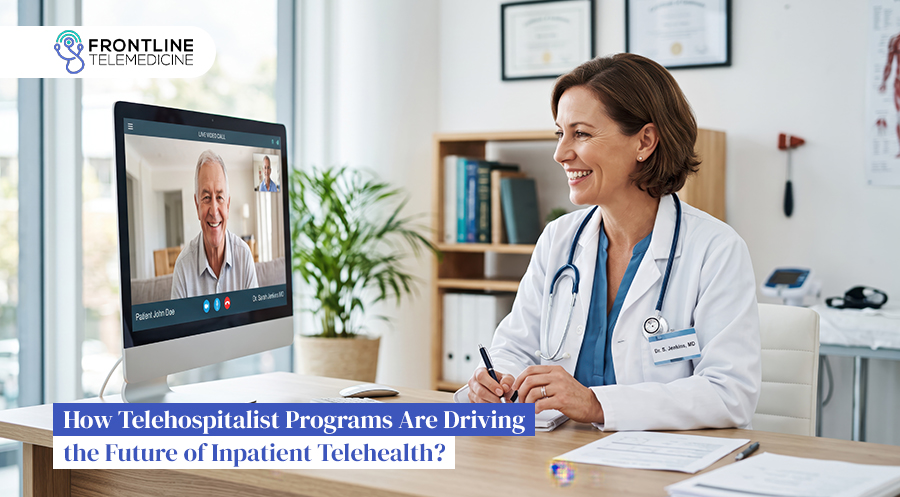
As of 2026, the modern US inpatient healthcare system faces an unprecedented physician shortage and soaring operational costs. To combat these mounting financial pressures, local facilities are rapidly adopting telehospitalist programs.
These programs by seamlessly bridging geographical divides, are fundamentally transforming inpatient care delivery. This vital infrastructure connects remote, board-certified specialists directly to local patients utilizing high-definition video and secure digital tools.
Many leading care hospital care organizations are implementing responsive telehospitalist technologies to expand hospital capacity and elevate care quality during vulnerable nighttime shifts or unexpected patient surges.
In this comprehensive guide, we will unpack exactly how telehospitalist programs are driving the future of inpatient telehealth. We will also explore the technological advancements that deliver measurable ROI for community hospitals. By the end, get best practices for implementing turnkey virtual solutions that future-proof your clinical infrastructure.
What Are Telehospitalist programs?
Telehospitalist programs connect remote, board-certified physicians to hospitalized patients through high-definition video carts and direct EMR access. These virtual specialists handle overnight admissions, routine rounding, and urgent cross-coverage without being physically present on-site.
For example, a rural critical access hospital (CAH) can deploy a tele-nocturnist to manage late-night emergency admissions. They can also perform virtual ICU consultations during clinical surges.
Key Features of Telehospitalist Programs:
• Real-time video connections using mobile medical carts.
• Direct integration with native hospital EMR systems.
• Immediate virtual access to certified hospitalist physicians.
• Live clinical monitoring using digital diagnostic peripherals.
• Collaborative supervision for on-site nurse practitioner teams.
• Rapid response times for urgent overnight consultations.
What Is Inpatient Telehealth?
Inpatient telehealth delivers virtual medical care, monitoring, and specialist consultations to patients already admitted inside a hospital. Using bedside video screens, cameras, and digital tools, off-site specialists, virtual nurses, or local doctors can assess vitals, review scans, and talk with families.
A disruptive system like inpatient telehealth solutions improves safety, expands specialist access, and streamlines continuous care. For instance, rural facilities can instantly beam off-site neurologists into stroke patients’ rooms. They may also benefit by using virtual nursing for rapid admission assessments.
Key Uses of Inpatient Telehealth:
• Continuous virtual ICU monitoring for critical patients.
• Remote specialty consultations without unnecessary patient transfers.
• Virtual nursing support for rapid bedside documentation.
• Live multidisciplinary team rounding with patient families.
• Live streaming diagnostic data from digital peripherals.
• Instant physician oversight for nurse practitioner teams.
The Growing Demand for Inpatient Telehealth
The demand for inpatient telehealth is surging in leaps and bounds. It’s because the healthcare systems confront crippling clinical staffing shortages and the rising medical needs of aging populations.
According to a February 2025 Fact Sheet by the American Hospital Association (AHA), the United States will face a projected deficit of up to 86,000 physicians by 2036. Such shortage disproportionately impacts rural and community hospitals. It’s forcing administrators to transition away from traditional on-site overnight coverage models.
Facilities are rapidly deploying virtual hospitalist programs to bridge geographic coverage gaps. Effective inpatient telehealth solutions like Tele-nocturnists, tele-cross coverage, and virtual rounding are helping healthcare settings to avoid the compounding financial strain of constant recruitment.
Primary Drivers of Inpatient Virtual Care:
• Severe Staffing Shortages: A shrinking pool of on-site nocturnal physicians and specialized clinical providers.
• Rural Healthcare Disparities: Bridging the geographic gap for facilities struggling with limited local medical infrastructure.
• Regulatory Compliance: Securing immediate, board-certified physician oversight for in-house Advanced Practice Providers (APPs).
• Cost Containment Strategies: Replacing expensive, unpredictable temporary locum tenens contracts with stable virtual budgets.
• Advanced Diagnostics: The proliferation of integrated digital stethoscopes and high-definition EMR-connected mobile tele-carts.
How Telehospitalist Programs Are Driving The Future Of Inpatient Telehealth?
Reliable telehospitalist programs drive the future of inpatient telehealth by mitigating critical hospital staffing shortages daily. These scalable solutions ensure your inpatients receive continuous care and reduces expensive patient transfers:
1. Tele-Nocturnist Programs
Virtual nocturnist programs drive future telehealth by securing seamless overnight care during severe staffing shortages. For instance, rural community hospitals prevent physician burnout when remote specialists handle all late-night admissions.
A continuous coverage model like this accelerates vital clinical response times while maintaining high standards for patient safety.
Key Points
- Immediate overnight patient admissions.
- Reduced daytime physician burnout.
- Faster clinical response times.
- Rapid remote order entry.
2. Tele-ICU Programs
Tele-ICU programs transform critical care in your health setting by delivering constant monitoring for high acuity patients. During sudden critical hospital surges, remote intensivist specialists quickly guide bedside nurses using live video feeds.
Such virtual oversight dramatically lowers mortality rates while preventing unnecessary patient transfers to distant tertiary facilities.
Key Points
- Continuous critical patient monitoring.
- Instant remote intensivist consultations.
- Reduced unnecessary tertiary transfers.
- Improved patient survival rates.
3. Tele-ICU Programs
Tele-ICU programs transform critical care in your health setting by delivering constant monitoring for high acuity patients. During sudden critical hospital surges, remote intensivist specialists quickly guide bedside nurses using live video feeds.
Such virtual oversight dramatically lowers mortality rates while preventing unnecessary patient transfers to distant tertiary facilities.
Key Points
- Continuous critical patient monitoring.
- Instant remote intensivist consultations.
- Reduced unnecessary tertiary transfers.
- Improved patient survival rates.
4. Tele-SNF Programs
Tele-SNF programs advance inpatient care by helping skilled nursing facilities treat fragile patients locally. When acute health changes occur overnight, virtual physicians evaluate residents immediately to prevent unnecessary emergency transfers.
It’s a specialized proactive management that optimizes facility bed utilization. Simultaneously, it reduces expensive hospital readmission penalties for health systems.
Key Points
Enhanced treat in place capabilities.
Fewer avoidable emergency room visits.
Lower hospital readmission penalty rates.
Immediate overnight resident clinical evaluations.
5. Tele-MD APP Supervision Programs
Physician APP supervision programs shape virtual care by empowering advanced practice providers through live oversight. When nurse practitioners encounter complex clinical cases, remote doctors offer instant consultation and direct order validation.
With this regulatory compliance framework, your rural facility can expand its operating capacity without hiring costly local physicians.
Key Points
- Live nurse practitioner clinical guidance.
- Full state regulatory compliance assurance.
- Instant order and treatment validation.
- Expanded hospital inpatient operating capacity.
6. Tele-Cross Coverage Programs
Inpatient operations are getting a new direction with Tele cross coverage programs. They optimize the system by handling routine overnight floor calls from nurses.
Instead of waking resting physicians for minor adjustments, remote hospitalists manage routine patient needs through software. A streamlined workflow improves overall nursing efficiency and also preserves daytime doctor energy for critical bedside care.
Key Points
- Rapid nurse page response times.
- Efficient overnight medication order management.
- Rested daytime hospitalist medical staff.
- Streamlined hospital floor care workflows.
Virtual Rounding Programs
Virtual rounding programs drive healthcare innovation with structured daily assessments for admitted hospital patients.
Remote doctors can connect with your bedside teams via digital medical carts to review vital patient care progress. It’s an incredibly collaborative approach which shortens patient length of stay. You can also ensure timely discharge planning across regional facilities.
Key Point
- Daily structured patient virtual visits.
- Reduced overall patient stay length.
- Timely hospital inpatient discharge planning.
- Seamless bedside clinical team collaboration.
Key Benefits of Telehospitalist Programs In Supporting Hospital Operations
Telehospitalist programs transform inpatient hospital operations by streamlining clinical workflows. They also improve interdisciplinary care coordination, and offer flexible, rapidly scalable virtual physician staffing models.
The key benefits are:
Operational Efficiency:
These inpatient care coordination programs dramatically accelerate overnight patient admission processing and eliminating care delays. They also maximize operational efficiency to a considerable extent. Remote physicians can handle clinical needs immediately, reduce the length of stay and optimize bed capacity.
Care Coordination:
Telehospitalist programs elevate care coordination by establishing seamless communication between remote specialists, bedside nurses, and local staff. With native EMR integration, you can enable instant order entry, unified treatment plans, and safer transitions.
Scalability:
Telehospitalist models allow hospitals to instantly adjust physician coverage during fluctuating patient surges by delivering flexible scalability. Your facility can expand inpatient capacity on demand without incurring steep local recruitment agency costs.
Technologies Enabling Telehospitalist Programs
Secure, high-speed digital tools power effective telehospitalist services. These advanced systems enhance let remote doctors manage inpatient care, do virtual rounds, and handle overnight admissions.
The table below highlights the technologies that are backing this digital hospital transformation and are enhancing hospital operational efficiency:
| Technology Category | Key Components & Tools | Clinical & Operational Value |
| Audiovisual Tele-Carts | Mobile medical carts, pan-tilt-zoom (PTZ) HD cameras, dual high-definition monitors | Enables virtual face-to-face patient exams, bedside nurse collaboration, and seamless mobility between hospital rooms. |
| Digital Diagnostic Peripherals | FDA-cleared digital stethoscopes (e.g., Eko Health), digital otoscopes, high-res exam cameras | Transmits live auscultation (heart and lung sounds) and clear visual exam data directly to the remote physician in real time. |
| Bi-Directional EMR Integration | Epic Systems, Oracle Health (Cerner), MEDITECH, Athenahealth integration | Allows telehospitalists to review patient history, enter clinical orders natively, and complete documentation directly in the hospital’s EHR. |
| Secure Telehealth Platforms | HIPAA-compliant WebRTC video engines, end-to-end encrypted cloud infrastructure | Guarantees strict data privacy compliance, high-availability video streaming, and low-latency communication during acute emergencies. |
| Network & Connectivity | Enterprise Wi-Fi 6 infrastructure, redundant 5G cellular failovers, secure IPsec VPNs | Prevents dropped calls during critical nighttime consultations, ensuring continuous video streaming and instant data transfers. |
| AI & Ambient Intelligence | AI-driven ambient documentation, real-time telemetry streaming, automated chart summaries | Reduces administrative friction for remote doctors, enabling faster clinical decisions and eliminating manual note-taking delays. |
Best Practices for Implementing a Telehospitalist Program For Inpatient Telehealth
Successful implementation of a telehospitalist model requires you to align technology, clinical protocols, and hospital staff through structured planning. Follow these proven best practices to ensure high clinical adoption and maximum operational efficiency from day one:
1. Conduct an Honest Clinical & Operational Needs Assessment
Assess facility-specific metrics including nighttime admission volumes, transfer rates, and current physician call burdens. By identifying specific operational bottlenecks, you can tailor virtual coverage precisely where it generates the highest ROI.
2. Establish Clear Clinical Protocols & Scope of Care
Define explicit clinical transfer protocols, emergency escalation paths, and cross-coverage responsibilities prior to launch. Clear guidelines make sure the coordination is seamless between remote tele-physicians and local care teams during acute patient events.
3. Secure Bedside Nursing Champions Early
Train and empower your local nursing staff. It’s because nurses serve as the primary hands and eyes for the virtual physician. Skilled nursing facilities benefit immensely from Tele-SNF services. Engaging nursing leadership early fosters high confidence during live tele-cart patient examinations.
4. Ensure Bi-Directional Native EMR Integration
Provide remote telehospitalists with direct, native access to the hospital’s EMR software. Direct entry enables real-time order placement, charting, and medication reconciliation without manual workarounds.
5. Partner with a Specialized Turnkey Provider
Select a specialized telehealth partner that handles end-to-end implementation including physician credentialing, hardware provisioning, and staff onboarding. A turnkey model eliminates technical friction and allows hospital leadership to launch without administrative strain.
Future-Proof Your Inpatient Care Strategy With Expert Telehospitalist Programs
Telehospitalist programs are redefining inpatient care by eliminating overnight coverage gaps, reducing physician burnout, and preserving vital hospital revenue. Rather than relying on costly temporary staffing or overburdened local doctors, you can future-proof your operations with a scalable virtual model.
Frontline Telemedicine delivers reliable, turnkey telehospitalist and tele-nocturnist coverage services. Our solutions are tailored for rural hospitals, Critical Access Facilities, and post-acute centers.
Contact Frontline Telemedicine today to schedule a customized consultation and transform your facility’s inpatient telehealth strategy.
FAQs:
What is a telehospitalist program?
A telehospitalist program connects admitted hospital patients with remote, board-certified physicians using high-definition video carts and direct EMR integration. These virtual specialists handle overnight admissions, routine daily rounding, and urgent patient cross-coverage in true real-time.
How do telehospitalist programs improve hospital operations?
Telehospitalist programs streamline hospital operations by eliminating overnight care bottlenecks and accelerating patient admissions. They prevent daytime physician burnout, reduce overall length of stay, and minimize costly, unnecessary emergency transfers to distant tertiary medical facilities.
Which hospitals benefit most from telehospitalist programs?
Rural hospitals, Critical Access Hospitals, community medical centers, and post-acute facilities benefit most. These organizations frequently face acute physician recruiting challenges, high locum tenens agency costs, and difficulty maintaining reliable overnight coverage for inpatient care.
What technology is required for a telehospitalist program?
Facilities require mobile tele-carts equipped with pan-tilt-zoom HD cameras, high-speed Wi-Fi, and digital diagnostic tools like stethoscopes. Seamless, bi-directional integration with the hospital’s Electronic Medical Record software ensures immediate clinical documentation and medication ordering capability.
How can hospitals implement a telehospitalist program?
Hospitals implement telehospitalist programs by partnering with a turnkey telehealth provider. The partner assesses clinical needs, credentials board-certified physicians, deploys EMR-integrated hardware, and conducts comprehensive hands-on training for bedside nursing staff before program go-live execution